Pebble HF
A 20-Meter Monoband HF Transceiver for Everyone
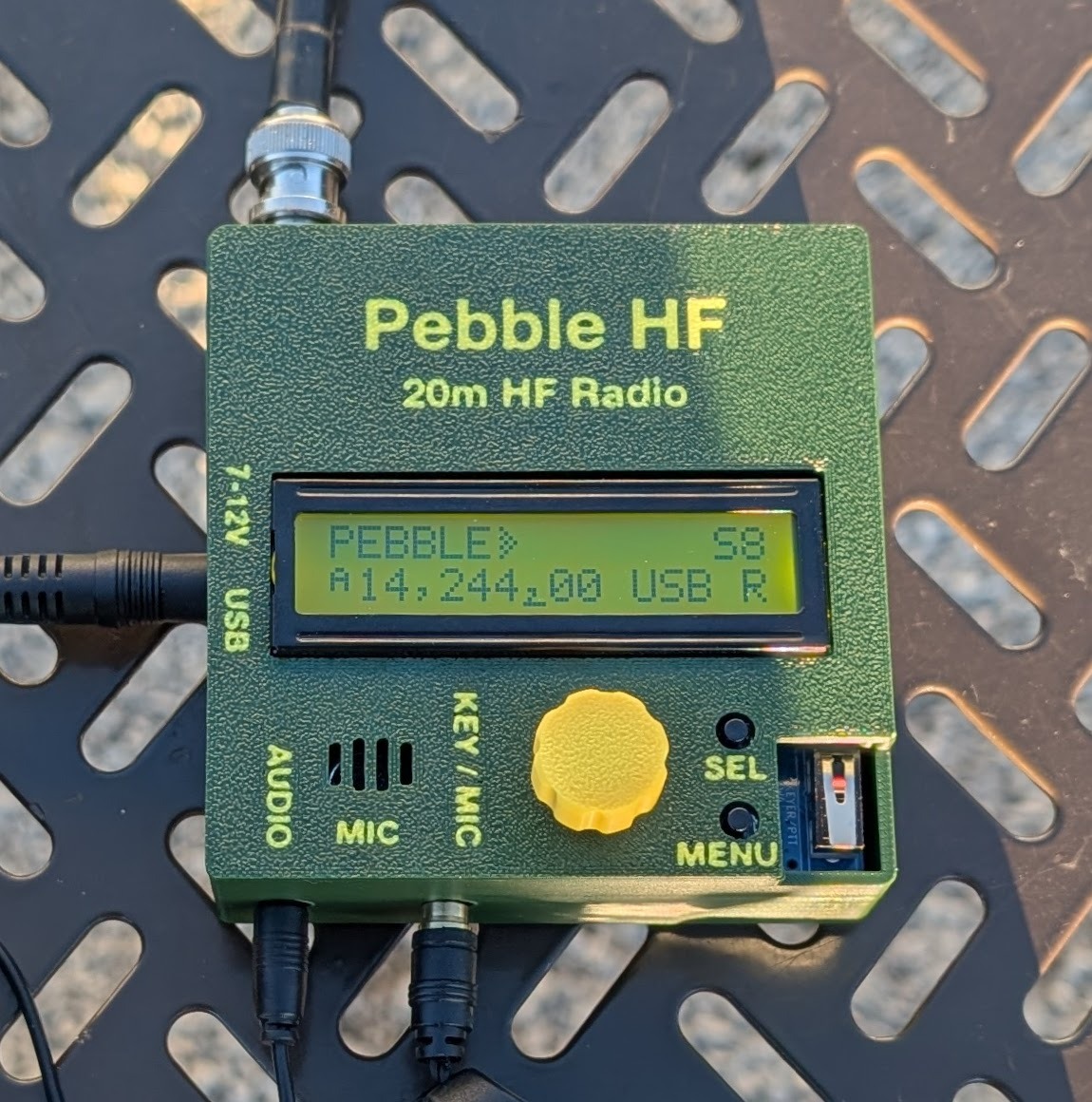
Pebble HF built up and fitted into a community-designed 3D-printed case, showing the display, tuning knob, and MENU/SEL controls.
Introduction
Pebble HF is an open-source, ultra-affordable, single-band QRP (low-power) HF transceiver built for the 20-meter amateur radio band (14.000–14.350 MHz). It supports CW (Morse code), SSB voice (USB/LSB), and digital modes such as FT8, JS8, and FT4 (with an external USB sound card). Weighing under 4.7 oz (132g), it delivers roughly 5W of output on 7–14V battery power or about 1W when powered from USB-C, making it a natural fit for portable operating styles like Parks on the Air (POTA) and Summits on the Air (SOTA).
What sets Pebble HF apart from most other QRP kits is its build philosophy: nearly all of its components are pre-populated surface-mount parts, leaving only about 14 simple through-hole parts for the builder to solder. Most people can finish assembly in under an hour, making it one of the more accessible entry points into building — and operating — an HF radio.
The project is a collaboration between HamRadioDuo (Becky, N4BKY, and Mike, N4FFF) and hardware designer Barbaros “Barb” Asuroglu (WB2CBA), building on firmware originally developed by Guido Ten Dolle, PE1NNZ.
The Aim of the Pebble HF Project
Pebble HF was conceived to lower the financial and technical barriers to getting on HF. The project’s stated mission is simple: get more people into HF ham radio and outdoor radio. Several goals drove the design:
- Affordability first. By restricting the design to a single band (20 meters) and using largely pre-soldered surface-mount construction, the parts cost and build complexity are both minimized, allowing the kit to be sold at an ultra-low price point.
- Ease of build. With only a handful of through-hole components left for the end user, the kit is approachable even for newcomers who have never picked up a soldering iron for RF work before.
- A genuine gateway radio. The project’s origin traces back to Mike N4FFF’s own early ham radio experience with a PIXIE kit — a classic ultra-cheap CW radio he was never able to make a contact with, due to its lack of filtering and tuning. Pebble HF was designed specifically to avoid that frustration: it is cheap like a PIXIE, but functional and enjoyable like a “real” SDR transceiver.
- Encouraging license upgrades and outdoor operation. By making a capable 20m all-mode radio inexpensive and portable, the project hopes to nudge Technician-class licensees toward upgrading to General class (needed for HF voice privileges) and to make outdoor/portable radio adventures like POTA and SOTA more accessible.
The project explicitly positions itself alongside other well-regarded QRP radios such as the QRP Labs QMX and the CFT1, rather than in competition with them — Pebble HF’s niche is being the lowest-cost, lowest-effort option for someone who just wants to get started.
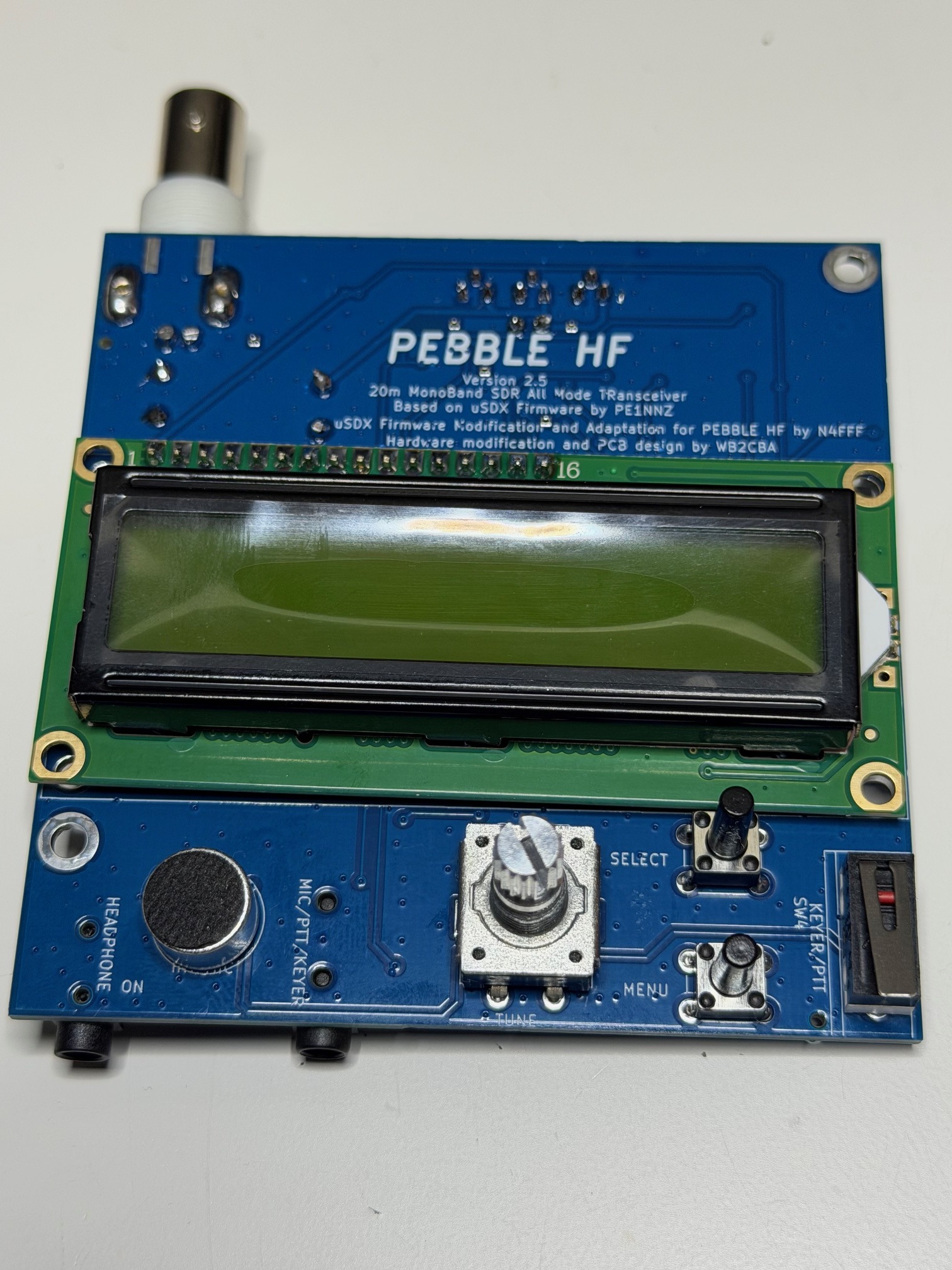
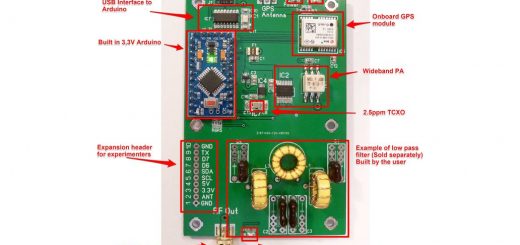
The Pebble HF front-panel board, showing its LCD, rotary encoder, MENU/SELECT buttons, and built-in mic — designed for a simple, low-cost user interface.
A Brief History: The uSDX Lineage
Pebble HF is not a from-scratch design — it is a direct descendant of the uSDX (micro Software Defined Transceiver) project, one of the most influential open-source amateur radio designs of the past decade.
The uSDX story begins with the QCX, a popular single-band CW-only transceiver kit sold by QRP Labs. Guido, PE1NNZ, developed an SSB (voice) modification for the QCX and announced it in the QRP Labs online forum. This modification evolved into its own project: the uSDX. Both the transmitter and receiver stages of the uSDX run entirely on a single low-cost ATmega328P microcontroller — the same chip used in the Arduino Uno — using direct digital synthesis and signal processing rather than conventional analog SSB generation hardware.
The software-based SSB transmit technique at the heart of uSDX traces back even further, to Guido’s earlier experiments generating SSB signals digitally on a Raspberry Pi by directly manipulating a PLL’s phase and frequency. He adapted that concept to the ATmega328P/Si5351 combination used in the QCX-derived hardware, creating a multiband front end and a direct PA biasing/envelope-generation technique that became the foundation for uSDX and its many hardware derivatives (uSDR, (tr)uSDX, QDX-style designs, and others) that have since proliferated across the QRP community.
Barb, WB2CBA took this proven uSDX firmware/hardware concept and adapted it specifically to create Pebble HF. He simplified the design down to a single band (20m) and converted as much of the circuit as possible to pre-populated surface-mount technology, in order to hit an aggressive cost target while retaining the capability of the original uSDX architecture.
Mike, N4FFF, subsequently took on firmware mods and maintenance for the Pebble HF-specific fork, adapting and refining the uSDX code for the Pebble HF hardware platform. The hardware and firmware repositories remain separate, mirroring the modular way the project is maintained.
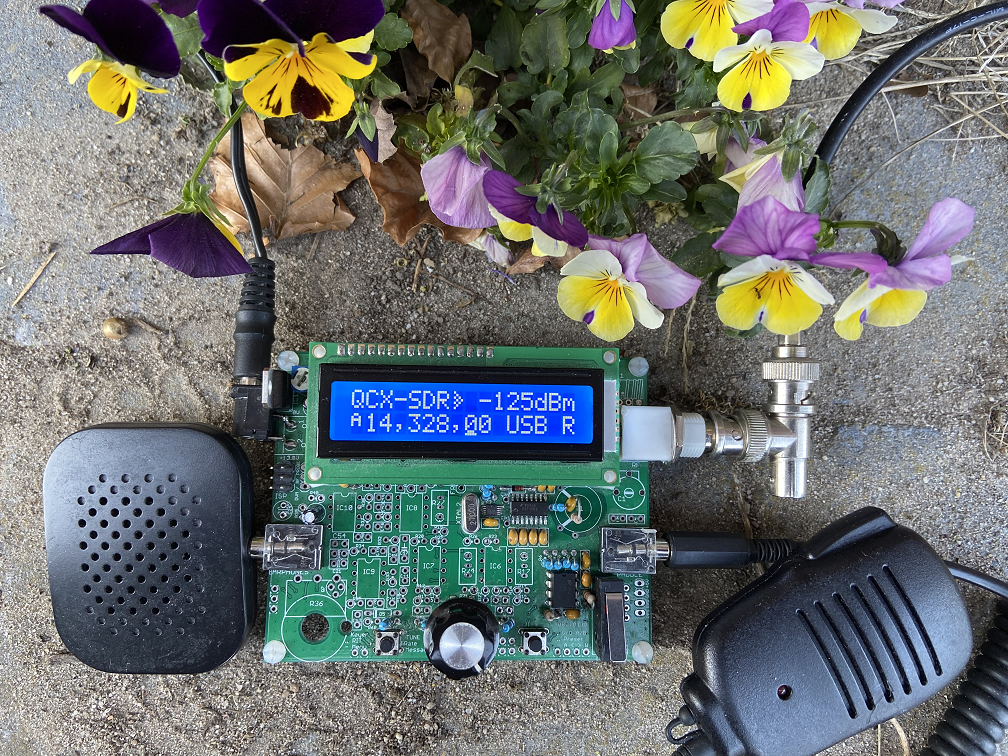
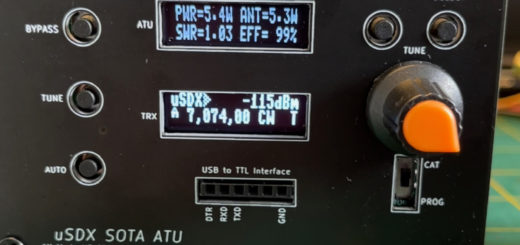
A QCX-SDR / uSDX-family transceiver in field use — the design lineage from which Pebble HF’s hardware and firmware descend.
Technical Details
Hardware Specifications
- Band coverage: 20 meters only (14.000–14.350 MHz), monoband
- Modes: CW, SSB (USB/LSB), plus digital modes (FT8, JS8, FT4) via an external USB sound card
- Output power: ~5W PEP SSB from a 13.8V supply (7–14V range); ~1W when powered via USB-C at 5V
- Power consumption: approximately 80 mA on receive, 500–600 mA on transmit at 12V
- Weight: under 4.7 oz (132g)
- Microcontroller: single ATmega328P handling both transmit and receive DSP
- Transmitter architecture: EER (Envelope Elimination and Restoration) Class-E driven SSB transmit stage — the microphone signal is sampled and an SSB signal is reconstructed digitally by controlling the phase of the Si5351 PLL (via high-speed I2C frequency changes) and the amplitude of the PA through PWM-based key-shaping. This avoids the need for a bulky, complex linear power amplifier or heatsinking.
- Receiver architecture: an optional fully digital SDR receive path samples I/Q signals from a quadrature sampling detector, performing the 90-degree phase shift mathematically in software (a Hilbert transform) to cancel the unwanted sideband.
- Signal quality: transmit opposite-sideband/carrier suppression better than -45 dBc, two-tone IMD3 better than -33 dBc; receive image rejection better than -50 dBc
- User interface: a rotary encoder (tuning/volume/step size), a MENU button, and a SELECT button, plus a built-in straight key and microphone (an external key/mic can be connected via a jack, which disables the onboard mic when in use)
- Build format: kit form with almost all parts pre-soldered as SMD; approximately 14 through-hole parts left for the builder, buildable in under an hour
- Fabrication: the PCB and SMD assembly files are published so the board can be ordered pre-assembled from a fab house such as JLCPCB
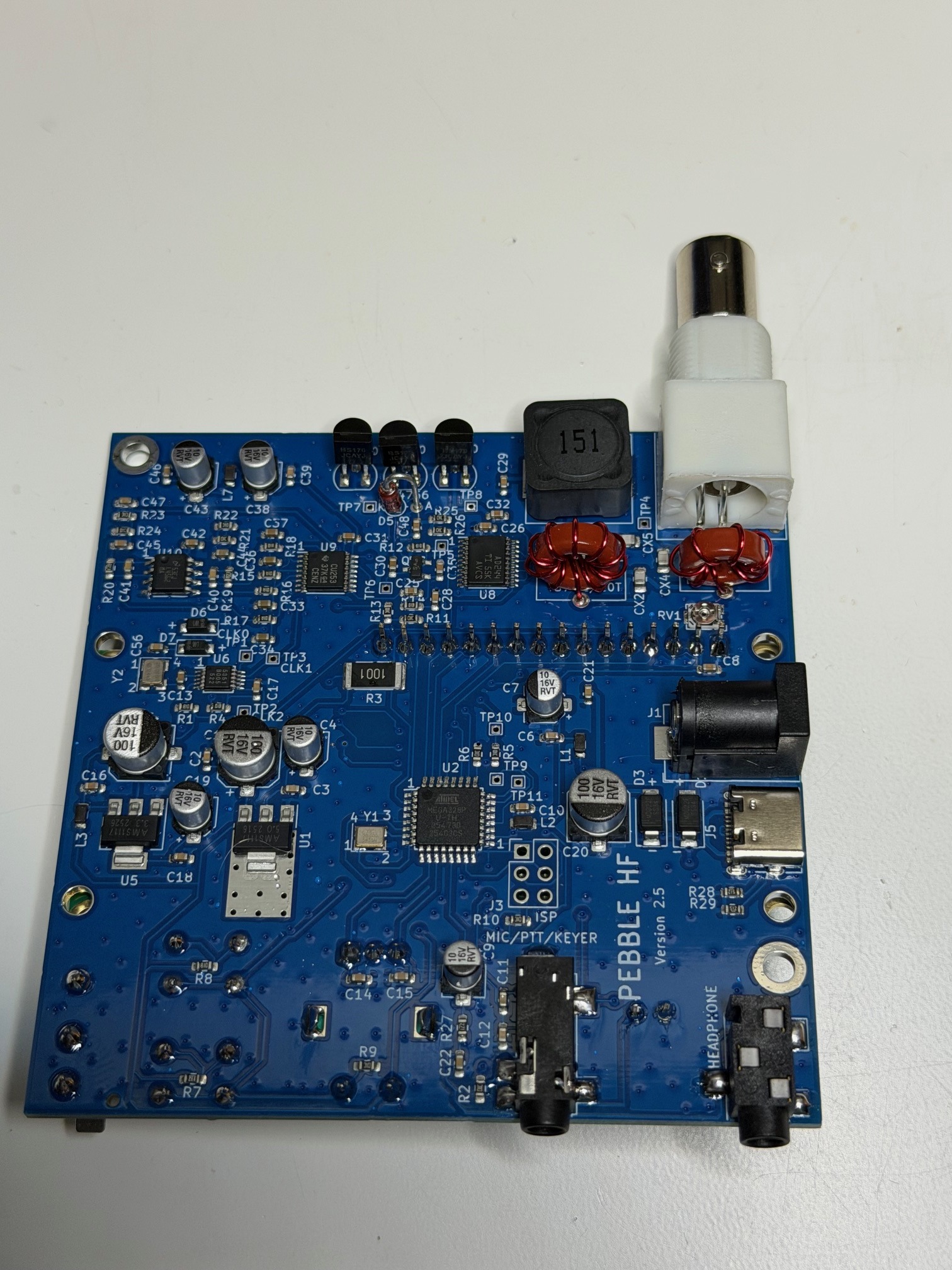
Close-up of the Pebble HF RF section, showing the hand-wound toroidal inductors and Si5351-driven Class-E PA stage.
Schematic and Hardware Design Files
The hardware side of the project — schematics, bill of materials, and fabrication files — is maintained by Barb WB2CBA in the PEBBLE-20m-HF-TRANSCEIVER GitHub repository. Key resources published there include:
- A full schematic (the “PEBBLE HF V2.5 SCHEMATIC” PDF)
- SMD fabrication files intended for direct submission to PCB assembly houses like JLCPCB
- A through-hole parts bill of materials (BOM) PDF for the parts the end user solders
- Pin-layout references for the microphone/PTT/key and headphone jacks
- Published RF performance measurements, including TX harmonic output plots and receiver SINAD measurements, documenting the design’s real-world performance
Because the hardware is designed to also accept the stock uSDX firmware, builders have the flexibility to run either the general-purpose uSDX firmware or the Pebble HF-specific fork on the same board.
Software / Firmware
The Pebble HF firmware is maintained separately from the hardware, in the usdx-pebblehf repository, and is a fork of the original uSDX Arduino firmware adapted specifically for the Pebble HF hardware platform. Notable software characteristics:
- Language/platform: written in C++ for the Arduino IDE (roughly 2,000 lines of code in the core sketch), with some supporting Python utility scripts
- License: MIT License
- DSP-based operation: all filtering, gain control, and demodulation happen in software on the ATmega328P — there is no dedicated analog IF filter hardware
- Selectable DSP filters: Full/open, and progressively narrower passbands (roughly 3000, 2400, 1800, 500, 200, 100, and 50 Hz, depending on firmware version)
- DSP features: Automatic Gain Control (AGC), noise reduction (NR), voice-operated transmit (VOX), adjustable RX attenuation, a TX noise gate, TX drive control, volume control, and a dBm/S-meter readout
- CW support: built-in CW decoder, plus straight-key and Iambic A/B keyer modes with configurable sidetone frequency
- VFO functions: dual VFO A/B with RIT (Receiver Incremental Tuning), and I2C-driven relay band-filter switching
- VOX-based mode switching: software VOX can act as a fast full break-in (QSK/semi-QSK) system for CW, or handle RX/TX switching for digital modes without requiring a separate CAT or PTT interface
- Menu-driven configuration: the MENU and SELECT buttons combined with the rotary encoder provide access to a full configuration menu, with a factory-reset option available at power-up
- Firmware updates: the radio ships pre-programmed, but users can reflash it either through a web-based updater or via the command-line avrdude tool, as documented in the project’s PROGRAMMING.md guide
- Version history: the firmware has iterated through a series of bug-fix releases (documented in the project’s changelog) addressing issues such as CW receive image-band bugs, audio “thump” artifacts between CW elements, and VOX false-triggering from sound-card DC bias
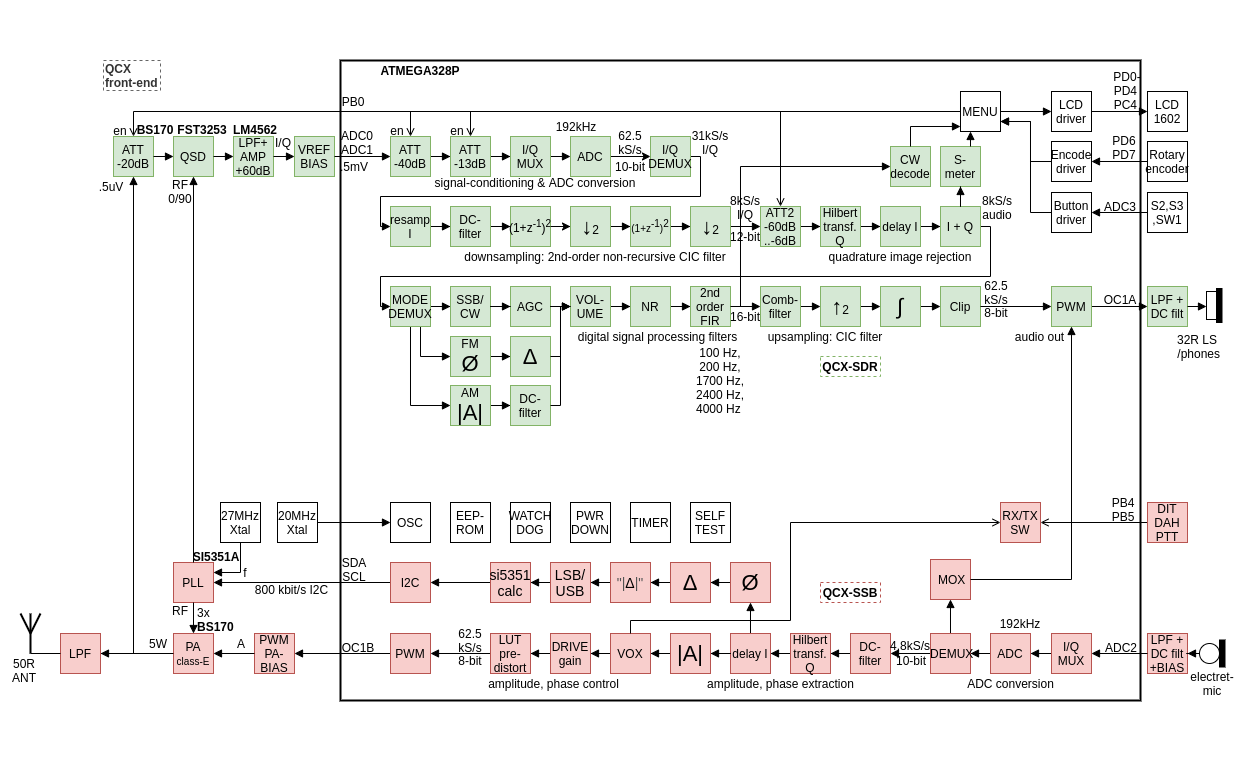
Block diagram of the uSDX signal-processing architecture — the ATmega328P-based DSP design that Pebble HF’s firmware inherits and adapts.
Openness and Community
Both halves of the project — hardware (WB2CBA/PEBBLE-20m-HF-TRANSCEIVER) and firmware (mspiceland/usdx-pebblehf) — are published as open-source repositories on GitHub, and the project maintains a Discord community for builders to troubleshoot and share modifications. As with many community-driven kits, it is explicitly sold and supported on a best-effort, community basis rather than with a formal commercial warranty.
Sources: pebblehf.com; GitHub repositories WB2CBA/PEBBLE-20m-HF-TRANSCEIVER and mspiceland/usdx-pebblehf; QRPer.com coverage of the Pebble HF launch and field use.